Points clés de l'article :
- Student concerns, commitment, and challenges regarding the climate situation
- The student "green gap": Barriers to responsible and eco-friendly consumption
- Illicogreen: Encouraging responsible consumption among students through a platform of committed brands and discount codes
- KLIMA School: Training work-study managers for the climate and energy transition
Young people today (aged 18-25) are more worried about their future than ever, as shown by the study conducted by IFOP for the Fondation de France: 90% of young people are worried about climate change. They are aware that they play a decisive role in climate action and that they must act and take initiative to help preserve the planet. The reasons for this movement are manifold. While there is rightful talk of the most committed and media-exposed student movements like Extinction Rebellion or Just Stop Oil—young people deeply engaged out of fear for the climate future—many students see an opportunity in joining a sector that could be described as being "on the right side of the fence." Indeed, this silent majority, who often state they want to "align their future career with their values," sees the energy and climate transition as an opportunity to do good. This allows them to avoid cognitive dissonance and take action while turning toward a future-oriented sector, sometimes by combining work-study programs and internships with their studies.
Student concerns, commitment, and challenges regarding the climate situation
We sought to understand how young people today are getting involved in this path, particularly through association work: Inès, a second-year Bachelor's student at ESCP, is involved in the GEA Sustainability association as the development manager for the Turin campus. She explains that the association operates around three main pillars: "making our campuses as green as possible, educating students, and establishing collaborations with eco-friendly sites to highlight our missions." This association is now present on all the school's campuses—London, Turin, Berlin, Paris, and Madrid. Inès's role as campus head in Turin allows her to get involved within her school: "We are currently working on a small scale on each campus, but we believe it can have a ripple effect and a greater impact in the long term." Why did she decide to get involved in this type of association? "Climate and sustainable development are key topics of the moment that we cannot escape (...) it's the future, everyone is talking about it, it's about how we will continue to live and exist as a community."
Similarly, Khouloud is committing herself to the climate situation by training in climate issues. With a background in agricultural engineering, she is joining the Master 2 program at KLIMA School, a way for her to think about others and future generations: "Since I come from a polluting field, I know what companies in that sector are like (...) we only thought about profit or how to cut costs. I realized that wasn't what I wanted to do, and I started to look into it: we see that biodiversity is collapsing, and planetary boundaries are being exceeded. What I was doing before didn't align with my values, and that's why I chose to change my trajectory."
Khouloud is completely changing her career path to deepen her knowledge in decarbonization, which she will be able to do at Klima School.
The student "green gap": Barriers to responsible and eco-friendly consumption
Despite the commitment of young people in the streets or in the media, a disparity still exists today between the ecological values that students advocate and their daily consumption, as well as their carbon footprint. We can therefore question the origin of this "green gap."
The report from the RESES National Student Council identifies three major barriers to more responsible consumption among young people. The first obstacle is the price of eco-friendly products, which are considered too high for a student budget (affecting 70% of those surveyed). The second barrier to this consumption is the lack of alternatives: students have little knowledge of the committed brands that could serve as an alternative to the well-known brands they habitually consume.
"We see that biodiversity is collapsing, and planetary boundaries are being exceeded. What I was doing before didn't align with my values, and that's why I chose to change my trajectory" - Khouloud Mila - KLIMA School student
Finally, the third barrier is the lack of information, as students feel they are not well-informed enough: this is caused by the "greenwashing" practiced by some brands, which consists of claiming to be virtuous without actually being so. It is therefore difficult to spot these practices when lacking knowledge on the subject, especially since environmental issues and their solutions are rarely taught in depth in schools and universities.
Illicogreen: Encouraging responsible consumption among students through a platform of committed brands and discount codes
To address the observed green gap, three students (Marion, Matéo, and Maxence) decided to develop a solution called "Illicogreen." Its goal is to encourage students to adopt responsible consumption while remaining accessible and providing visibility to committed brands within the target student market. To this end, Illicogreen.fr is a platform that lists committed brands and offers discount codes to students. The site provides alternatives to meet all types of daily needs and even beyond (alternatives for vacations). The platform categorizes its brands to meet everyone's needs and tastes: food, fashion, hygiene and beauty, services, home, and miscellaneous. Students can register for free with their school certificate or student ID card to gain access to the discount codes.
Illicogreen selects its partner brands based on a charter that takes into account environmental, societal, and social criteria, as well as future prospects for improvement in these areas. In return, partner brands gain attractiveness and credibility with a valuable target audience: it is a win-win for all parties involved.
KLIMA School: Training work-study managers for the climate and energy transition
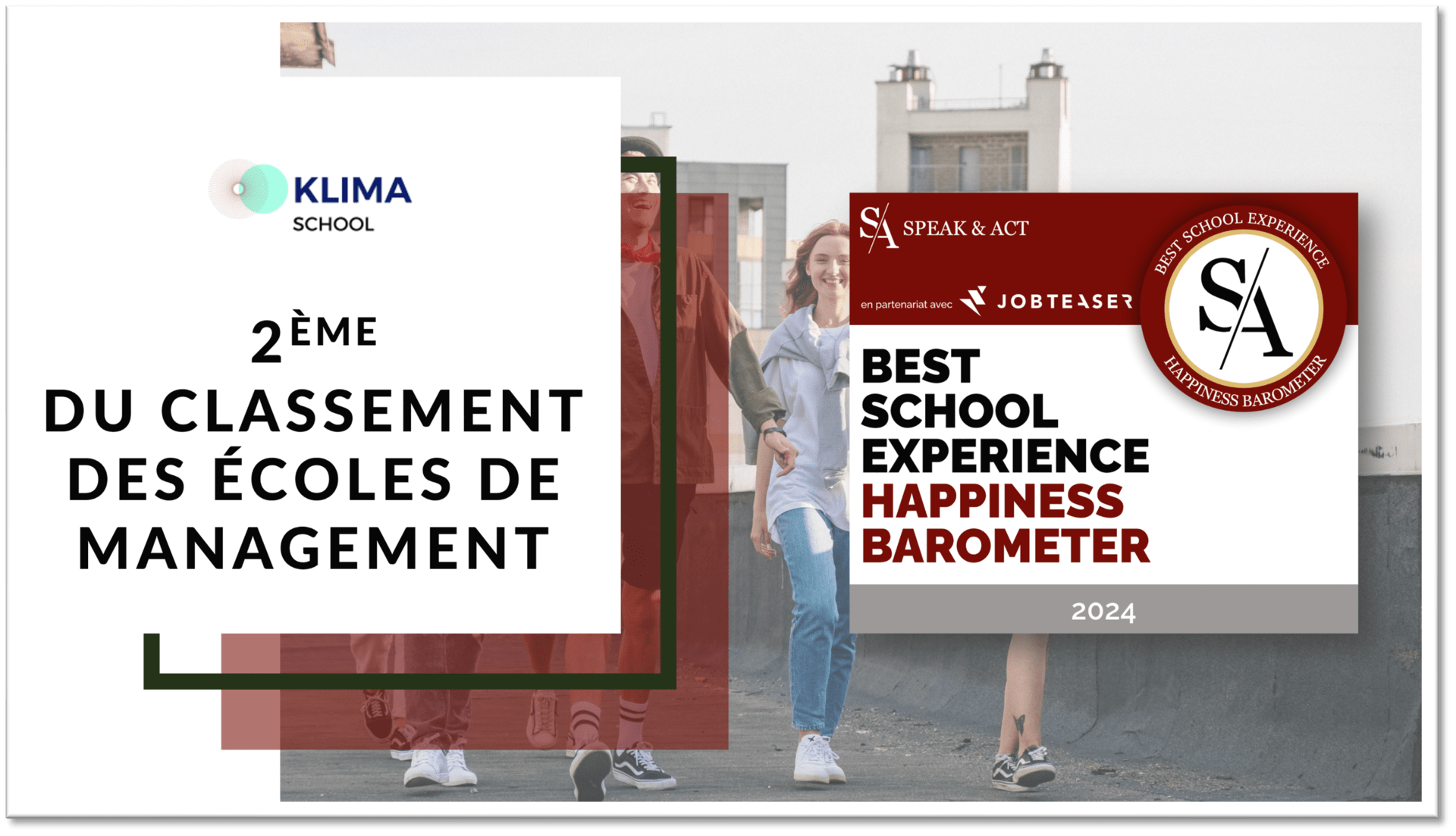
After noting that climate issues were absent from 90% of higher education curricula in France (Shift Project) and that the climate transition represented an opportunity for both students and companies, the KLIMA School team designed a professional training program that integrates energy and climate issues into the core of a new-generation, work-study business school. What is Klima School ? It is the first business school dedicated to the climate, energy, and CSR transition. Klima School trains responsible managers who are aware of the climate, economic, and environmental challenges of the 21st century: they know how to respond to the challenges of tomorrow in terms of project management to contribute concretely to the energy transition and reduce the carbon footprint of companies.
The school offers its students a dual curriculum in management and climate-CSR transition. By adapting traditional business curricula, Klima School focuses on innovation in its programs to attract students of all levels who wish to train in work-study program to contribute to a sustainable, decarbonized, and energy-efficient future. From undergraduate to master's level, it offers programs in initial and work-study program work-study formats to allow its students to put their knowledge and skills into practice in the field.
Khouloud, a KLIMA School student for the September 2023 intake, explains the importance for her of following a program that combines climate transition and CSR: "Thanks to my professional experiences, I became aware of sustainable development and environmental protection. I realized that what I was doing was not in line with my principles. My goal today is to hold a position that supports companies in their sustainable development efforts, something I will be able to do thanks to a work-study program at this school within a large group that is looking to decarbonize its activities and operations."